
· La rédaction de Tadaksahak TV · Event
Rose Walet Moussa: “Coming to bury them is not enough”
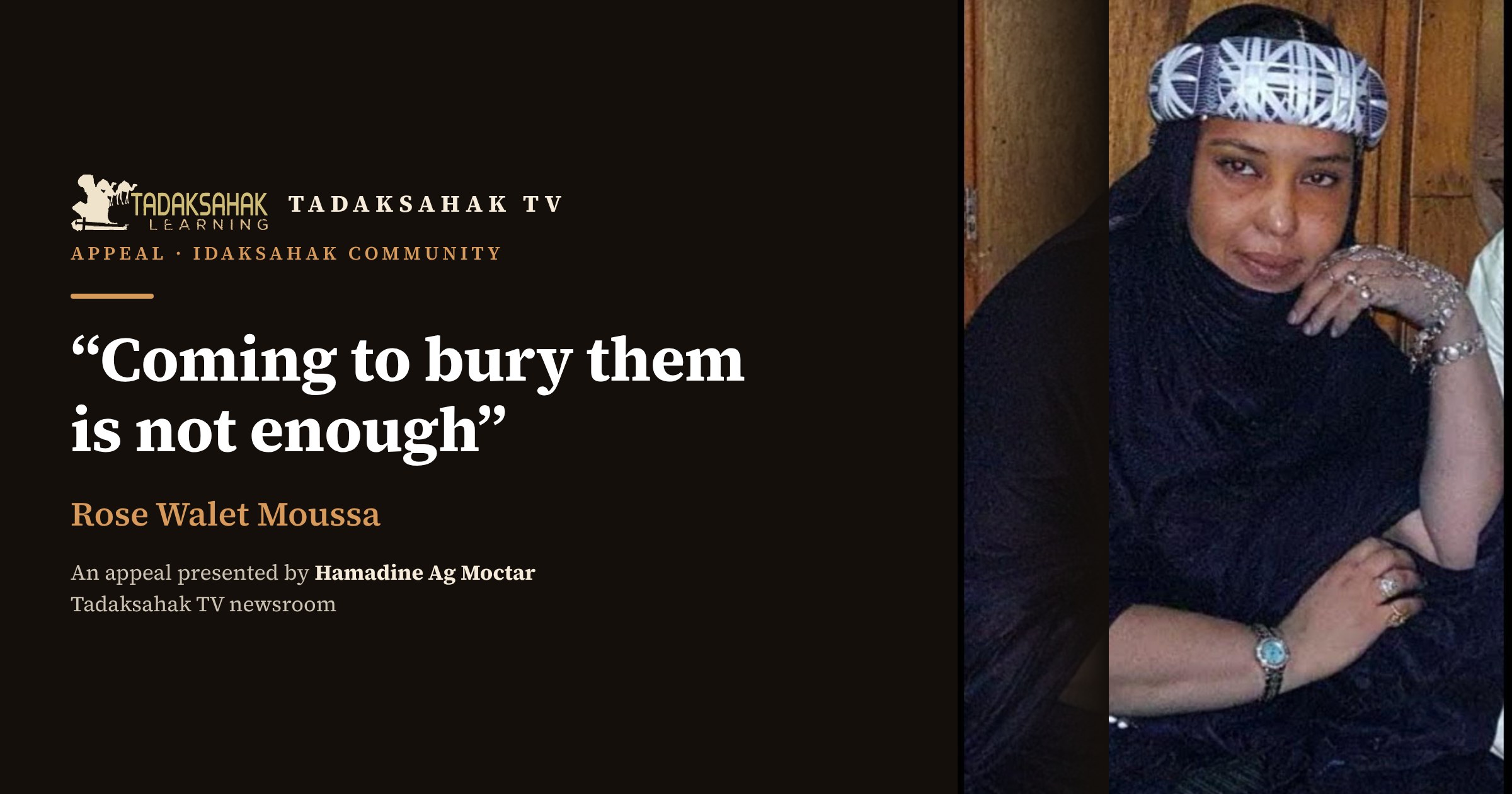
After the massacre of 48 civilians at Tagadayat, Rose Walet Moussa — a daughter of the Idaksahak community, based in New York, and for years committed to her people — appeals to Mali’s leaders, to ECOWAS and to international organisations: save the living, now.
Rose Walet Moussa is neither an association nor an NGO. Based in New York, this daughter of the Idaksahak community has stood by her people since 2012, in good times and in the worst. When massacres strike the Ménaka region again and again, she does not look away: she mobilises, around her and out of her own pocket, to support her community. Recently she raised more than 84 million CFA francs to support her own people. Her voice is one our readers already know. After the killing at Tagadayat, some fifty kilometres from Ménaka, she entrusted us with this appeal. We publish it exactly as she sent it to us.
Her appeal
Ménaka, 24 October 2026.
To our Malian leaders, to ECOWAS, and to all who are watching what is happening to us: 48 civilians were killed at Tagadayat, about 50 kilometres from Ménaka. They were our elders, our sheikhs, our fathers — innocents who were fighting no one. Terrorists entered their community and killed them.
It took the army three days to come and bury them. Three days. Where was the help while they were still alive? Who will save the families still in danger?
Even now, the terrorists take everything the families own and leave them without food, without water, without their animals — which are all their wealth and their means of living. These families make their own way to Ménaka. No one comes to their rescue. When they arrive, it is residents who barely have enough to live on themselves who feed them and find them somewhere to sleep.
Where is our government? Why must a hungry child wait for meetings and plans? Why can our country not bring food, medicine, clothing and blankets within a few days? We cannot wait months for a bag of rice and a tent while our families suffer.
We need our army to save people while they are still alive. Coming to bury them is not enough.
Mali is our country, and we trusted this government. Why are we left to face all this alone?
Supporting their own, by their own means
What Rose Walet Moussa describes, a whole community is living. For years, the Idaksahak have buried their dead, taken in their survivors and supported their victims by their own means, where the State does not reach. In Ménaka, it is families who barely have enough to live on who feed those who arrive empty-handed, having lost everything.
But those means are running out, as is the community itself. Behind the figures lies a fear few dare to name: that of an extermination advancing, methodically, while the world stays silent. That silence wounds as deeply as the weapons. People come to bury the dead; no one comes to save the living.
An appeal to the world
This appeal is not a cry of anger. It is a precise request, addressed to those with the power to act:
- to the Malian State, to protect its civilians and bring relief to the displaced families of the Ménaka region — food, water, medicine, shelter — in days, not months;
- to ECOWAS and to international organisations, humanitarian and human-rights alike, not to look away from the Ménaka region and to open access to aid there;
- to the Idaksahak diaspora and to all people of goodwill, to relay this appeal and to support, however modestly, the families surviving on their own strength alone.
Rose Walet Moussa has asked for no title and no recognition. She asks that the living be saved while there is still time. We owe her at least this: to carry her voice.
— The words of Rose Walet Moussa, gathered and published by the Tadaksahak TV newsroom. Ménaka — New York, 24 October 2026.
Sources
- Rose Walet Moussa, appeal to the international community, 24 October 2026 (text entrusted to the newsroom).
- Executive Bureau of the Idaksahak community, communiqué, Ménaka, 19 October 2026 (provisional toll of 48 civilians killed at Tagadayat on 18–19 October 2026).
- See our article “Tagadayat: The Duty Not to Look Away”.
- United Nations: at least 157 civilians killed in the Ménaka region, 8–28 March 2022.
- Human Rights Watch, “Mali: Islamist Armed Groups Committed Coordinated Massacres”, 27 October 2022.