
The Man Between the Lines
From the sands of Ménaka to the code that saves a language
تأليف Hamadine AG MOCTAR · 2026
Hamadine AG MOCTAR, founder and editor of Tadaksahak Learning and Tadaksahak TV. An account drawn from his words, his songs, his documents and his images.
© 2026 Hamadine AG MOCTAR. All rights reserved. Any quotation must cite the author, the title and the year; any reproduction, even partial, requires the author’s permission.
الاطلاع متاح مجانًا لتعلّم التاداكساهاك والتعرّف على إدكساهق. ويجب أن يذكر كل نسخ، كليًا كان أو جزئيًا، المؤلفَ والعنوانَ والسنةَ والمصدرَ (هذا الموقع)، ويُمنع كل نسخ دون ذكر المراجع. شروط الاستخدام
A story of resilience: from Ménaka to the camps of exile, a man who lost an arm and refused to fall silent — and who saved a language with a line of code. Illustrated edition, with his documents, photos and songs.
Foreword
This book was born of a refusal: the refusal to let a life, a people and a language fade away in silence.
It was written from the words of Hamadine Ag Moctar himself — the long poem he entrusted to us, in which he describes himself as "the man between the lines" —, from his songs, his documents, his photographs, and everything he has built before our eyes: a platform, a television channel, a radio station, a dictionary, an album, a memory. Nothing here is invented. The images and records that accompany it are not illustrations: they are evidence. Hamadine wanted them to appear in these pages, because those he served have forgotten him, and they must remember what they owe him: security, and stability — everything the Sahel lacks.
Part of this account touches on sensitive years: Hamadine served as an interpreter with an international coalition committed to protecting civilians. At his request, his service and the truth of what he endured are told here without evasion. Only operational details — those that could expose others than himself — are deliberately withheld; the faces of those who did not consent likewise do not appear, and on the reproduced documents a registration number and the name of a third party have been masked. Out of respect, too, the women who crossed his life are not named. This is a choice of caution for others, not a silence about himself.
This is not a hagiography. Hamadine doubts, weeps, sometimes gets things wrong — he says so himself. But he moves forward. Always. And that is precisely what this book tries to hold on to: not a perfect man, but a man standing.
Prologue — The one they call when no one else understands
There are men whose stories are told. And there are those who are listened to.
Hamadine is of the second kind. You cannot sum him up in a line of civil records; you read him between the lines, exactly where he has always lived: in the space between two languages, between two worlds, between what is said and what is left unsaid.
He is a man whose pen is sharpened like a sabre — for in the desert, words too are blades: they cut through lies, they open passages, they defend those who have nothing else left to defend themselves. He is a translator of silence, an interpreter of the heart: he listens not only to what people say, but to what they dare not say, and he carries it across to the other side, intact. He is a poet of exile and a coder of hope — two callings that are one and the same in him, for what is a program, if not a poem that acts?
Picture a man from whom the world has taken a great deal — an arm, a homeland, loved ones, the right to live in peace — and who, with the hand he has left, still holds the world he dreams of translating. A world where every word heals, where every gaze understands, where every silence tells the truth.
That world does not exist. So he builds it. Line after line. In French, in English, in Arabic, in Tadaksahak, in Hausa — and above all, he says, "in human."
He is that silent cry the powerful do not hear, but which the children of the dunes recognise in the beating of their hearts. He is the man you call when no one else understands. And when he speaks, truly, with all his truth, a strange thing happens: even the wind stops to listen.
Here is his story.
Chapter One — Origins: a people the maps erase
"I grew up without gold, but rich in sorrows, / Between two worlds, two tongues, a thousand hours." — Hamadine, "Inaltérable"
To understand Hamadine, you must first understand where he comes from: the Idaksahak.
They are a people of north-eastern Mali, in the Ménaka region, on the edges of the Sahel and the Sahara. A nomadic, pastoral, Muslim people, as old as the tracks that link the wells. The Idaksahak speak Tadaksahak — a rare and precious language of the Northern Songhay group, born of the meeting between Songhay and Tuareg Berber. A crossroads language, in the image of those who carry it: people of the in-between, go-betweens, translators by necessity and by vocation.
But Tadaksahak was almost never written down. It was passed on by word of mouth, at evening gatherings, in the songs and proverbs of the elders. And a language that is not written is a language that can be made to disappear.
That is Hamadine's first wound, before all the others: to know that his people live on lands redrawn without them, in narratives where they do not appear, with a language that no one, on the outside, thinks to save. "Not to write your own history," he would later say, is to accept that others write it in your place, or erase it.
Hamadine was born on 3 June 1998, in Ménaka, to a father whom exile already held far from his own, and to a mother who refused the fate reserved for the women of her generation: illiteracy. That mother did not resign herself. She learned, she studied, she forged a reputation through sheer strength of character, and she is today one of those voices her community listens to. It is from there, first of all, that Hamadine draws his refusal of erasure: from a woman who decided that no one, ever, would decide in her place what she was worth.
The son only carried on the mother's vow. She had refused ignorance for herself; he would refuse it for an entire people. He grew up, as he sings, "without gold, but rich in sorrows, between two worlds, two tongues" — and very early, he understood something many never learn: sometimes, the silence of a people is worth more than a thousand televised shouts. It just needs someone to translate it.
He would be that someone.
Chapter II — Languages, or the art of becoming a bridge
"He speaks French, English, Arabic, Tadaksahak, Hausa, and the rest. But above all, he speaks human."
One does not become a polyglot out of comfort. One becomes one out of necessity, then out of love.
Hamadine learned Arabic at the source of the Qur'an, French from administration, English from contracts and from the world, Tadaksahak from evening gatherings, Hausa from the marketplace. And above all these languages, he speaks a sixth, one with no grammar and found in no textbook: the universal language of solidarity. Each language is a door; he opens them all, not to settle inside, but to let others pass through.
For very soon, his gift became a trade: interpreter, translator. The one who stands in the middle, who keeps meaning flowing, who stops a misunderstanding from becoming a tragedy. In a region where a mistranslated word can trigger suspicion, and suspicion violence, the interpreter is no mere relay: he is a craftsman of peace. Between two dialects, he weaves peace; between two cultures, he builds a bridge called empathy.
But Hamadine does more than translate languages: he translates lives. He translates pain into projects, absences into poetry, barriers into digital bridges, and rejections into vocations. What, in another, would turn to bitterness, becomes in him something to build with. That is his signature: he does not seek to please, he seeks to serve. He "forged his voice in the thread of silence," his song says — and that voice, from then on, would no longer fall quiet.
Chapter III — The Takuba years
"He walked on burning lands, carrying his language like a weapon and his people like a flag."
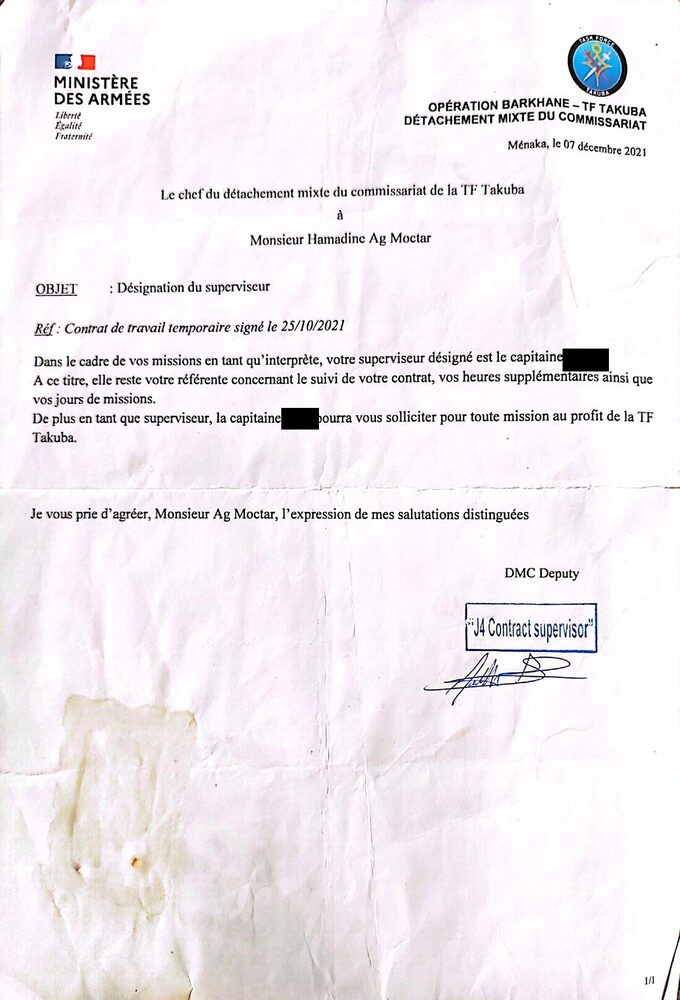
From 25 October 2021, Hamadine put his languages at the service of an international coalition engaged in the Sahel — Task Force Takuba, attached to Operation Barkhane. He served there as an interpreter. In December 2021, an official letter from the joint commissariat detachment in Ménaka even assigned him a supervising officer to oversee his missions: proof that he was regarded as a full professional, and not as a mere pair of hands.
Let this be clearly understood, for it is the heart of everything: Hamadine did not join Takuba to make war, nor to "fight terrorists." He joined it to protect civilians. His own life, he says without emphasis, was worth no more than those of the thousands of innocents massacred in sheer injustice on these lands. So he took up the only weapon he knew how to wield — speech, translation, understanding between people — and he placed it at the service of those who had no one to hear them. He walked on burning lands, carrying his language like a weapon and his people like a flag.
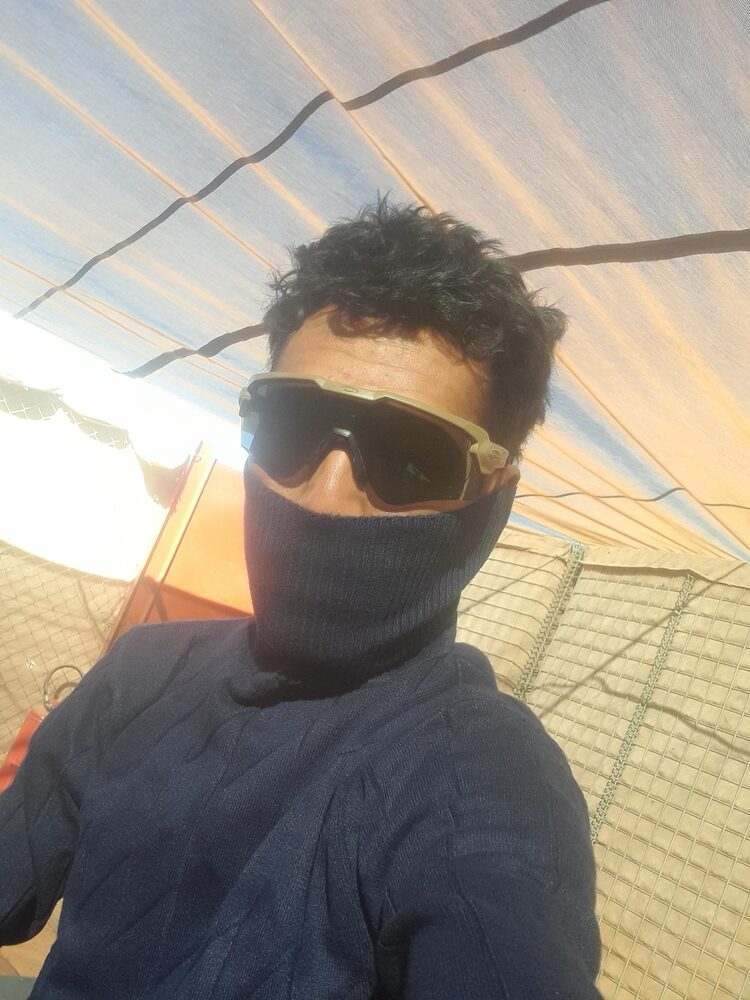
Official documents speak to his worth. A letter of appreciation signed by a head of his unit praises his reliability, his expertise, and his ability "to keep a low profile while providing translation of a very high standard"; his excellent English allowed him to support allied units. "For every task, Mr Hamadine Ag Moctar has shown reliability and expertise."
And there is this document: a letter from the Ministry of the Armed Forces, on the letterhead of the French Republic, officially designating him as an interpreter of Task Force Takuba. A document from Paris. Hamadine holds on to it, and he is right to: it attests, in black and white, that France called upon him, and that it knows who he is.
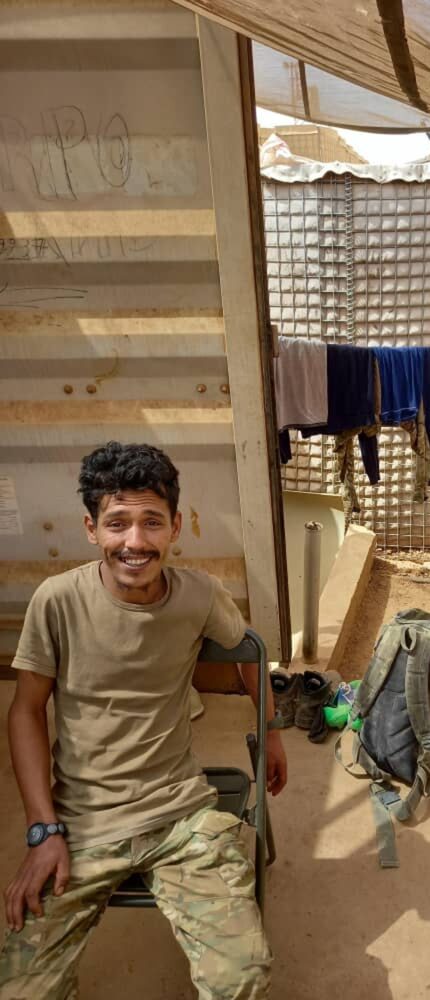
Out of respect for others, certain details of these missions will remain untold — not out of shame, but out of caution, for in this region words can still cost lives. What can be said is said, head held high: he served, for the civilians, and he was recognised.
He served. He was recognised. And he was about to pay — a price no one should ever pay.
Chapter IV — The night of 22 August 2022
"My arm fell, but I kept my voice, / My soul remained even when all vibrated cold." — Hamadine, "Inaltérable"
On the night of 22 August 2022, everything changed.
That night, terrorists came for him — the very ones whose victims he had sought to protect turned against the translator, against the man who was putting words to their crimes. Then, like cowards, they disguised their act as an accident, so that nothing could be proven.
It was that night that Hamadine lost his left arm.
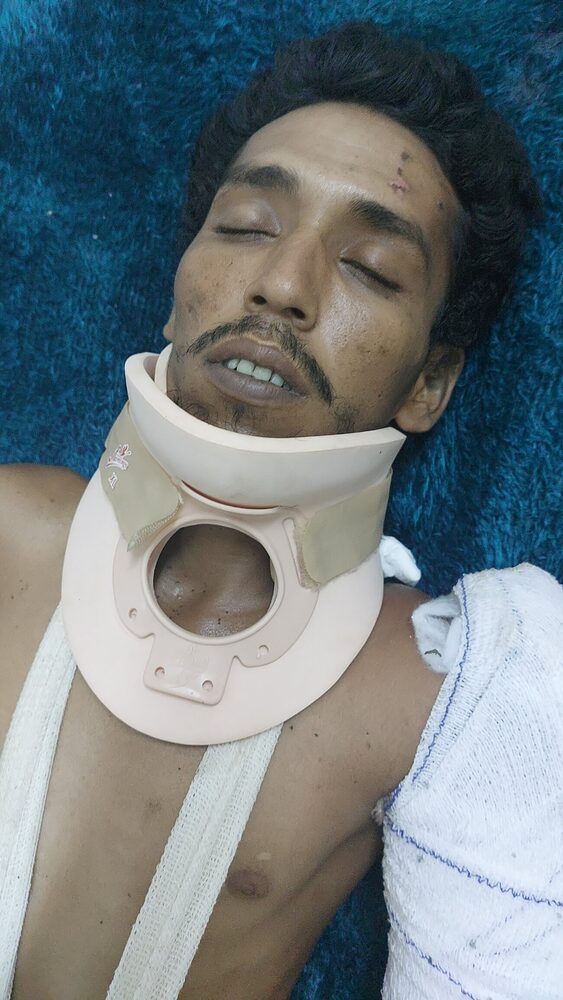
And as if the mutilation were not enough, others — accomplices, lurking in the shadows — would later spread a vile rumour: that he had been driving drunk. It must be written here once and for all, in black and white, since this book is the place of truth: it was not an accident, and there was no drunkenness. There was a target — him —, because he had chosen the side of the civilians; and there were, afterwards, slanderers too cowardly to own their act, who tried to soil what they had failed to silence.
A man whose arm is torn away learns, in a single second, everything life will ask of him from then on: to do more, with less, without complaint. His arm fell; he kept his voice. His soul remained, even when all vibrated cold. Hamadine no longer has his left arm. But in his right hand, he still holds the world.
He drank at the source of pain. But he did not drown in it. He made of it a sacred fire — the one that would later light everything he was going to build.
Chapter V — The humiliations
"I saw betrayal, the eyes that light up; / Still standing, even when the night chokes me with smoke." — Hamadine, "Inaltérable"
People think the worst, for a man, is the wound. It is not true. The worst is what comes after: the slow, repeated, administrative humiliation of the one who gave everything and is now told to wait his turn.
Hamadine has known the camps. The queues. The waiting rooms where you grow old on your feet. The "come back tomorrow"s that, end to end, end up stealing years. He has known those counters where an administrative gaze scans your name without ever seeing your soul; where you are no longer a man with a history, a courage, a sacrifice, but a line in a file, one case among others, a number.
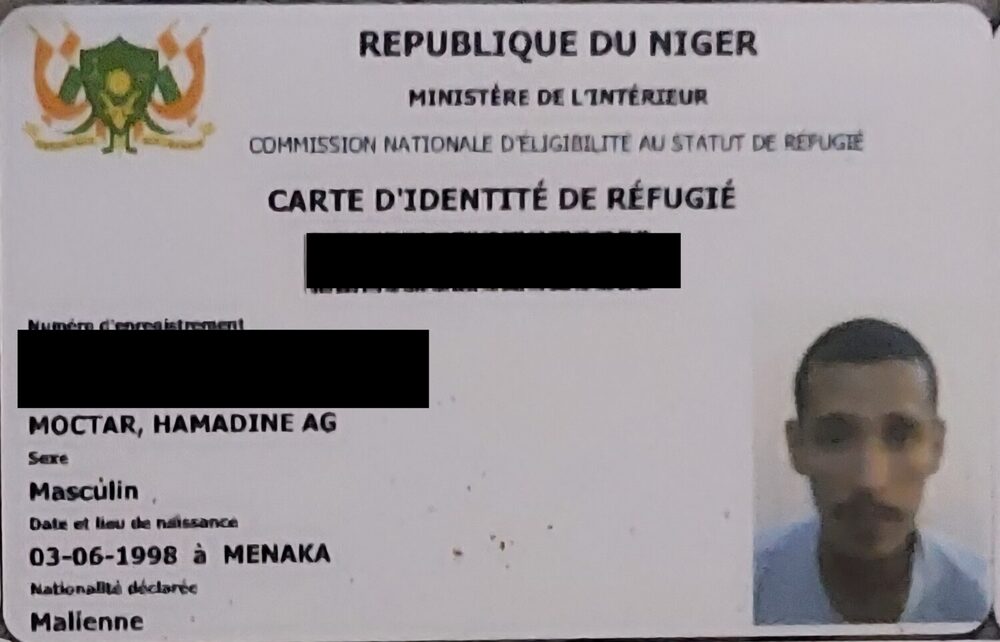
Look at this card. Everything on it is correct: the name, the date, the place of birth, the nationality. And yet everything is missing from it. You cannot see that he served an international coalition. You cannot see the arm he left behind on the night of 22 August. You cannot see the language he is saving, nor the children he is fighting for. You see a refugee, a number, a status. It is precisely against this that Hamadine rose up: he refused to be a number. He chose to be a voice.
For there is, in his story, an injustice that must be named. Hamadine served those who claimed to defend peace in the Sahel. He paid with his flesh. And today, those same people have forgotten him. This book is also here to remind them, without anger but without evasion: they owe him what is most lacking on these lands — security, and stability. Not as a favour. As a debt.
Another would have collapsed, or sunk into bitterness. He made a choice few make: to turn humiliation into fuel. Every closed door became a reason to build his own house. Every "come back tomorrow" became a day of work stolen back from fate. He does not wait for someone to open a door to him: he builds the opening.
Chapter VI — Tadaksahak Learning: saving a language with a line of code
"You can save a culture with a line of code, a verse, a voice."
This is where the story turns a second time — and where the wounded, humiliated, forgotten man becomes a builder.
Why. Because a language without writing is a language on borrowed time. Because a people erased from the maps ends up erased from memory. Because Hamadine could not bear the thought that Idaksahak children would grow up without a single place, anywhere in the world, where their language would be written, taught, respected. "The need to know my origins," he says. Tadaksahak Learning was born of that need, multiplied by all the children to come.
When. When no one believed in it. That is the detail Hamadine insists we not forget. No patron at the start, no NGO, no ministry. One man, alone, with an idea most thought unrealistic: to build, from nothing, the digital home of a rare language.
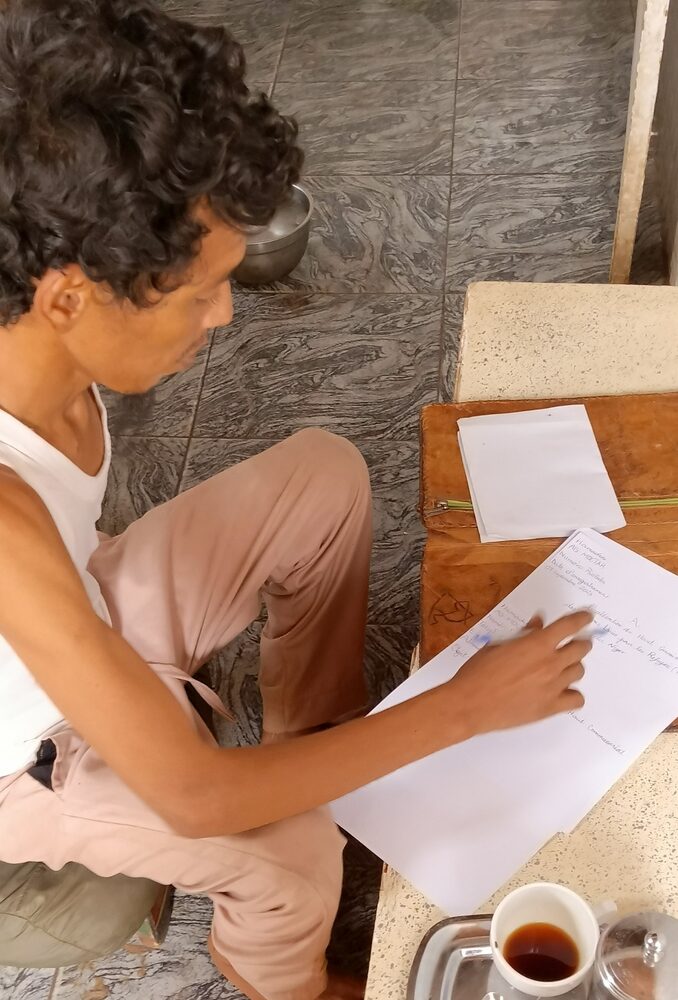
How. By learning. Hamadine made himself a developer as he had made himself an interpreter: out of necessity, then out of passion. A man the world had tried to break by every means, and who rebuilt himself in version 3.0 — stronger, deeper, more human than all the algorithms combined. He writes "in JavaScript the way he writes poems." He codes tools so that even the forgotten can speak their language and be understood. He designed, page after page, a true ecosystem: a dictionary of Tadaksahak, a grammar, a phonology, a library, folk tales, a historical timeline; then Tadaksahak TV and Tadaksahak Radio, with live broadcasts, replays, newscasts in several languages; then Tudú, an assistant that knows the site and answers questions; and even a book, On the Trails of Those of Ishaq, sold to keep the project alive.
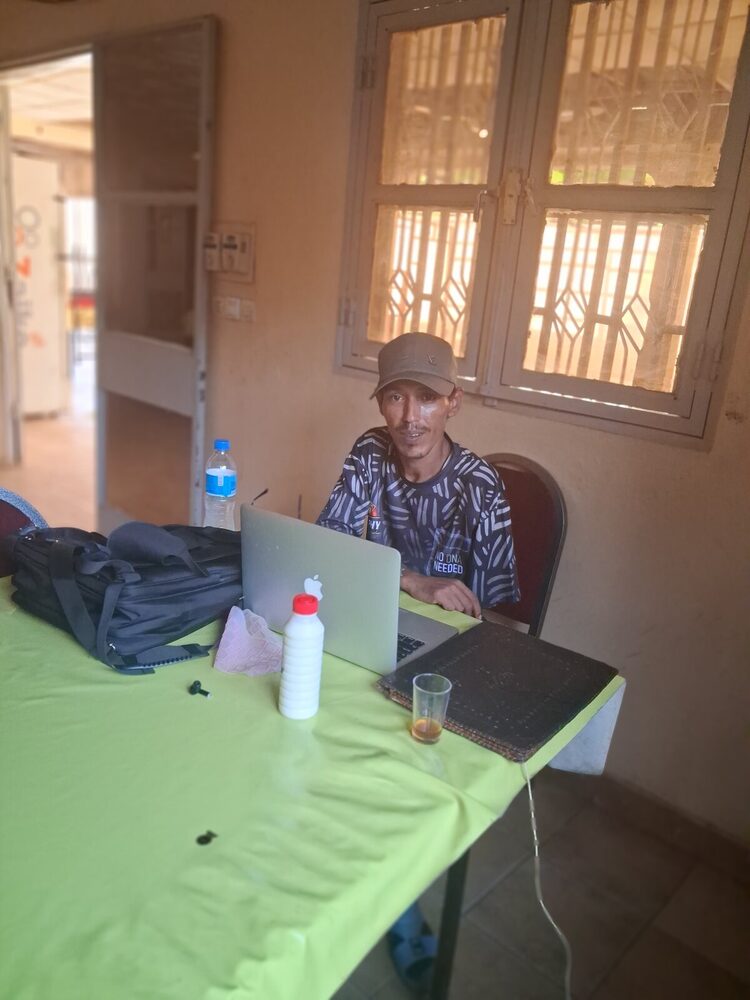
With what. With almost nothing. A second-hand computer, a laptop, a phone, a microphone; willpower, and many nights. A man who codes with a single hand — the right one —, because the other is no longer there. Every line costs him what it costs no one else, and he writes it anyway.
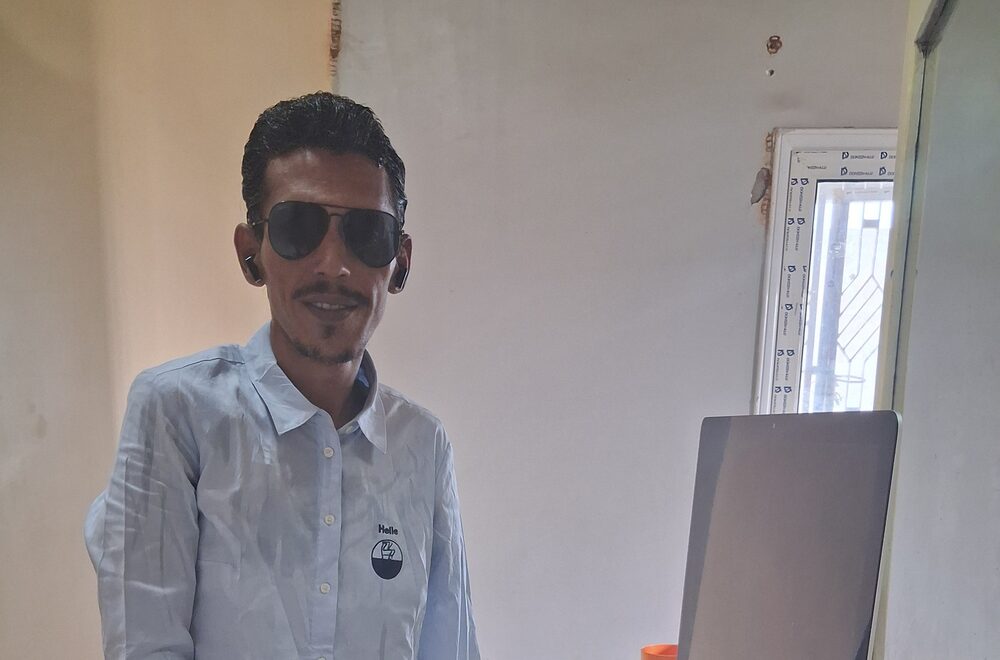
For to him, writing is an act of resistance. Every word becomes a prayer, every function a restitched scar. He does not write to be read: he writes so that people remember. As he raps: he does not count the likes, he counts the scars.
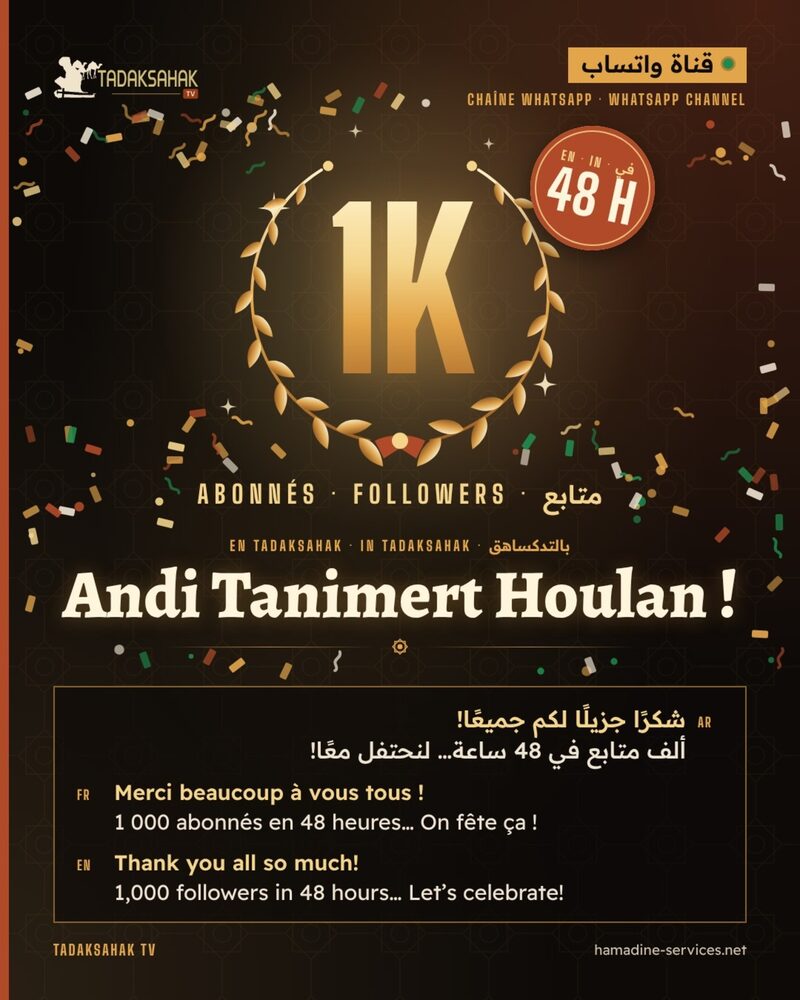
And then, one day, the answer came — not from the experts, but from the public itself: 40,000 visits in 7 days.
Forty thousand. In one week. For a language the world thought condemned to silence, carried by a man the world had thought condemned to vanish. Those who did not believe got their answer. It does not fit in a speech. It fits in a number, and in what that number means: they had been forgotten; they are here.
Chapter VII — The man between the lines
"He is a father. He is a son. He is a brother to all wounded peoples."
It would be a mistake to see in Hamadine only a founder, a survivor or a symbol. Above all, he is a man — with the tenderness and the contradictions that this implies.
He is a father, and that governs everything. In his notebooks, he says, dreams come in triplicate: one for himself, one for his children, one for the children he will never know but whom he already protects through his actions. He was seen, his neck held in a brace on a hospital bed, letting the tiny hand of a baby touch his face — an image that says, better than anything else, why he refuses to stop.
He is a son — the son of a mother who refused illiteracy as one refuses a sentence, and who became, through sheer will, one of the voices her community listens to. What the mother made of herself, the son did for an entire people. He carries her voice as she taught him to carry his own. He is a brother to all wounded peoples.
He believes in God — not as an excuse, but as a source of courage; he believes in destiny, but not in chance. Before the night of 22 August, he played the guitar under the stars and grilled meat for his loved ones — simple joys, from a time when he had both his arms, which violence tried to tear from him without quite succeeding.
He has known love, and loss, and the impossible return. He speaks of it the way one speaks of shooting stars: knowing the light is brief, but that it marks you forever. Out of respect for those who crossed his path — and because he promised to name no one —, this book will say no more than he does: he loved, he lost, he rebuilt, and sometimes even forgot to live in order to survive.
He is the inkwell of Allah and the scribe of the forgotten; the shoulder of lost causes; the father who will never flee, the friend you call at midnight, the professional respected in silence. He doubts, he weeps, he errs. And he moves forward.
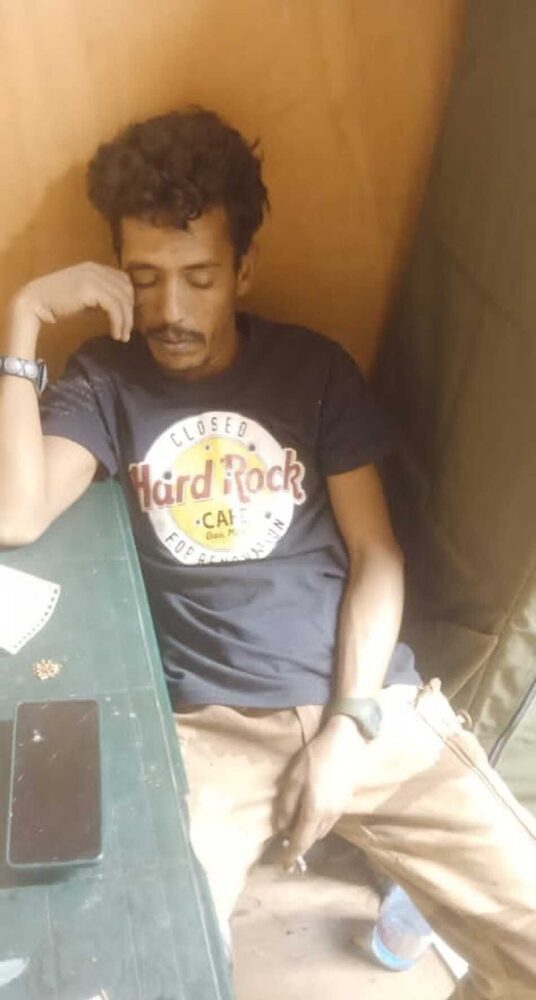
He is not here to shine. He is here to give light.
Chapter VIII — The dunes set to song
"I carry my truth, no need for a costume; / I move forward with my fire, it's for them that I ignite." — Hamadine, "Inaltérable"
There is one thing that neither the wound nor exile could take from him: song.
In 2024, Hamadine released his first album — Les dunes de ma vie ("The Dunes of My Life"), under the label he named Studio Les Dunes. A personal work, "exploring the themes of resilience, inner journey and identity." Each track, he says, is a stage in this voyage across the dunes of existence.
Six tracks, like six stations along the trail:
• Debout encore ("Still Standing") — a hymn to resilience;
• Le Chemin d'Hamadine ("Hamadine's Path") — one man's singular journey;
• Rien qu'un homme ("Just a Man") — the title track, where he refuses to be made more, or less, than what he is;
• Inaltérable ("Unalterable") — on inner strength, the kind nothing can erode;
• Si elle fuit, ne cours pas ("If She Flees, Do Not Run") — a reflection on love and freedom;
• Respire ("Breathe") — an invitation to pause, to peace.
Where the book explains, the song cuts to the bone. In a few lines, Hamadine says everything this account takes chapters to tell:
I grew up without gold, but rich in sorrows, / Between two worlds, two tongues, a thousand hours; / I saw fear, I knew absence, / But I forged my voice in the thread of silence.
There is betrayal, and the refusal to bend: "Brothers lost, promises shattered, / But I stay whole, impossible to fold." There is, above all, the reason he creates — not for glory, but for his own:
I don't rap for the views, I rap for my people, / For those who go hungry, for those who are smothered. / I am the echo of a struggle, of a forgotten land, / But I keep my dignity, never tamed.
And there is this verse, in which his whole story holds in eight bars:
I don't count the likes, I count the scars (…) / My arm fell, but I kept my voice, / My soul remained even when all vibrated cold. / Hamadine isn't a stage name, it's a trace, / It's a divine mission that no fire can replace.
A man who has lost an arm and still sings "still standing" has no need for a legend to be invented for him. He composes it himself, and he signs it.
Chapter IX — The vision: the Elder of the future
"Saharan in soul, universal in vision, humble in the moment, and a giant in history."
What does Hamadine want, in the end?
He wants a language to stop dying. He wants children to be able to say, one day: "here is our dictionary, here is our grammar, here are our tales, here is our television" — and to say it without shame, without asking forgiveness for existing. He wants a world where every word heals, where every gaze understands, where every silence tells the truth.
There is, in this man, a rare synthesis: the griot who keeps the memory, the developer who puts it online, the resister who does not bend, and the mystic who seeks higher than himself. You might call him the Elder of the future: someone who walks towards tomorrow carrying all of yesterday on his shoulders.
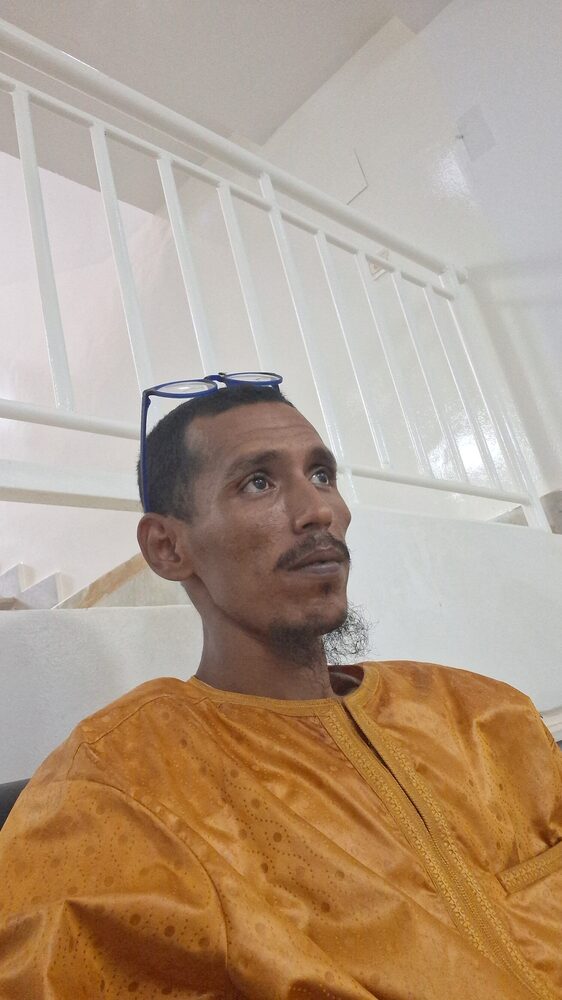
He could flee. He could please. He could say what people want to hear. But he chooses the truth, even when it costs him — because he knows his mission is greater than his comfort. He is a reliable witness: not a mythologised hero, a real one.
One day, this world will hear his voice. Not because he will shout louder. But because his truth will weigh more than all the hypocrisies combined. And on that day, people will understand what this book has tried to say from its very first page: that a man can be on his knees with exhaustion and still remain, despite everything, standing in a world on its knees.
Tadaksahak Learning is not a website. It is a declaration: we exist, we write our own history, and we ask no one's permission.
Epilogue — It is only beginning
"I do not wait for opportunities: I try to create them."
You wanted Hamadine's story told.
He cannot really be told. He is listened to. He is read. He is lived.
He is the man between the lines. The one who turns pain into mission and mission into art. The one who, with every reason to sink, refused to sink — and, above all, refused to leave his community in ignorance.
He lost an arm; he kept the world in the other hand. He was erased from the maps; he re-inscribed himself in memory. He was reduced to a number; he answered with a voice. He was not believed; forty thousand people, in seven days, answered in his place.
And the story is not closed. A man like him is not told in the past tense. Before him there is perhaps a new land — exile, this time, could become a beginning — and, wherever he goes, the mission will travel with him: a language to save, a people not to be left in ignorance, children to whom he will bequeath something other than silence. This book itself is only a first stone. It will grow, as everything Hamadine touches grows.
For such is his motto, and it sums everything up: he does not wait for opportunities; he creates them.
The last word he has already written himself, at the end of his song. It is not a summing-up. It is a promise:
Hamadine… I'm not finished, I'm alive.
— An account set down for Hamadine Ag Moctar, founder and editor of Tadaksahak Learning and Tadaksahak TV, author of the album "Les dunes de ma vie," from his words, his songs, his documents and his images. First edition, to be completed and corrected by his own hand.
Tadaksahak Learning · Tadaksahak TV — www.hamadine-services.com
Translated from the French.
الاستشهاد بهذه الوثيقة
المرجع
Hamadine AG MOCTAR (2026). The Man Between the Lines. https://hamadine-services.net/ar/bibliotheque/2984 (تاريخ الاطلاع 2026-10-25)
BibTeX
@book{moctar2026between,
  author = {Hamadine AG MOCTAR},
  title = {{The Man Between the Lines}},
  year = {2026},
  url = {https://hamadine-services.net/ar/bibliotheque/2984},
  urldate = {2026-10-25}
}