
On the Trails of Those of Ishaq
An Essay on the Origins, Journeys and Exoduses of the Idaksahak: the State of the Evidence, Hypotheses and Lines of Inquiry
تأليف Hamadine AG MOCTAR · 2026
Hamadine AG MOCTAR, researcher and developer, founder of the site, member of the research group appointed by the Permanent Secretariat of the Idaksahak community (chair: the Honourable Moussa AG Acharatoumane), research commission chaired by Mohamed AG Nadroun. A personal essay contributed to the group’s work: its propositions await the group’s decision and do not bind the commission.
© 2026 Hamadine AG MOCTAR. All rights reserved. Any quotation must cite the author, the title and the year; any reproduction, even partial, requires the author’s permission.
الاطلاع متاح مجانًا لتعلّم التاداكساهاك والتعرّف على إدكساهق. ويجب أن يذكر كل نسخ، كليًا كان أو جزئيًا، المؤلفَ والعنوانَ والسنةَ والمصدرَ (هذا الموقع)، ويُمنع كل نسخ دون ذكر المراجع. شروط الاستخدام
First edition (October 2026). The author sets side by side all the sources gathered by the research group on the origins of the Idaksahak, following the method of independent families of sources, and distinguishes what is established (the name, the composite character of the group, the Songhay nature of the language, its place within the Iwellemmedan ettebel) from what belongs to tradition or remains under debate. He follows the paths that tradition and history ascribe to the Idaksahak and their neighbours, from the route of the Massūfa, the Berbers who were masters of the western Sahara in the fourteenth century (Collet 2024), here brought into relation with the “Western Berber” substrate that Lameen Souag (2015) detects beneath Tadaksahak, down to the exoduses of the last half-century, and devotes a chapter to the open letter of 30 May 1958 from the chiefs of the Niger Bend. He submits twelve propositions to the group and provides a chronology, an annotated translation of the letter with a critical note and a verified bibliography. Finally, he opens six new leads, among them the Timbuktu chronicles (Tārīkh al-sūdān, Tārīkh al-fattāsh, al-Bakrī) pointed out by Albachar Ag Hamadou and the road from Gao to Takaddā travelled by Ibn Baṭṭūṭa in 1353, and publishes in an appendix Shaykh Baye’s manuscript notice on the Dawsahaq.
Appendix C. Shaykh Baye’s Notice on the Dawsahaq: Manuscript, Text and Translation
This document was communicated to the author by Charles Grémont, who had published it in his book on the Iwellemmedan (Grémont 2010*), together with Judith Scheele’s French translation. Below are a description, the photograph, the Arabic text, the translation and an English rendering of it, followed by a critical note.
C.1 The document
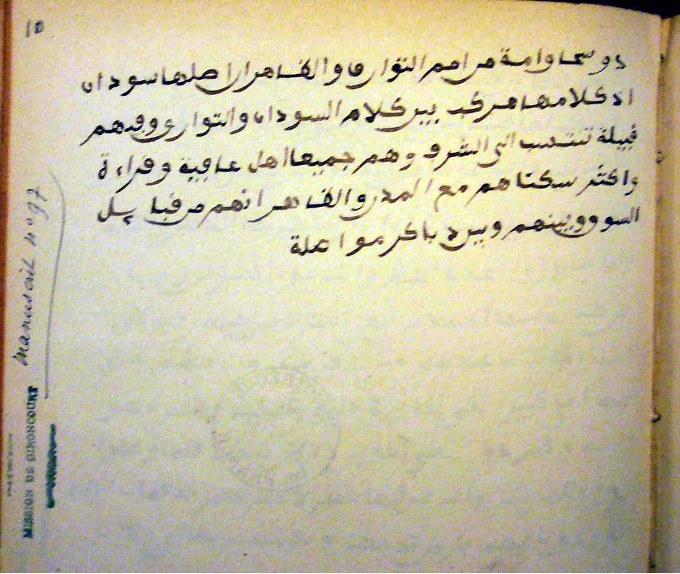
Manuscript by the Kunta scholar Shaykh Baye al-Kuntî, collected from its author at Aguelhok by Georges de Gironcourt during one of his missions (1908–1912). It belongs to a set catalogued under the general title “Notes sur d’anciennes tribus touareg” (“Notes on ancient Tuareg tribes”), held in the library of the Institut de France (MS 2407, items 91 to 104, fourteen pages). The notice devoted to the Dawsahaq is number 97.
The manuscript is undated. The note accompanying the translation places its writing between 1895, the year in which Shaykh Baye succeeded his elder brother at the head of the zāwiya of Telaya, and 1912, the year it was collected.
The photograph of the whole page shows the text at the top of a leaf numbered 10. In the margin are a stamp reading “Mission de Gironcourt” and the pencilled note “Manuscrit n° 97”; lower down, the library’s stamp. Number 97 is thus the number the mission gave to the manuscript.
C.2 The Arabic text
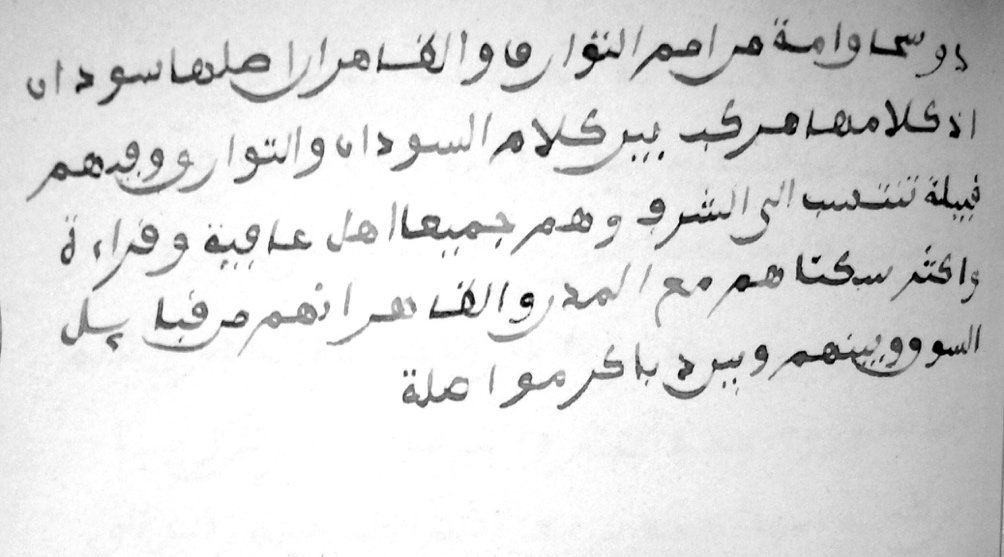
Transcription by the author, from the photograph; the slash marks the end of each line of the manuscript. The Saharan script does not mark all the diacritical dots, restored here, nor the vowels. The transcription should be checked by a reader of Saharan manuscripts.
دوسحاق أمة من أمم التوارق والظاهر أن أصلها سودان / إذ كلامها مركب بين كلام السودان والتوارق وفيهم / قبيلة تنتسب إلى الشرق وهم جميعا أهل عافية وقراءة / وأكثر سكناهم مع المدن والظاهر أنهم من قبائل / السوق وبينهم وبين دباكر مواصلة
C.3 Judith Scheele’s translation
97 – Dawsahaq. Les Dû Sahâq sont un peuple des Touaregs. Il est certain qu’à l’origine ils étaient Sûdân, car leur parler (kalâm) est composée des mots (kalâm) des Sûdân et des Touaregs. Et parmi eux (il y a) une tribu qui situe ses origines vers l’Est. Ils sont tous des gens de la paix et de l’étude. La plupart d’entre eux habitent avec les Ilmidan [Iwellemmedan]. Il est évident qu’ils sont des tribus d’Es-Suq. Entre eux et les Dabâkir il y a des relations.
English rendering of the French translation: “97 – Dawsahaq. The Dû Sahâq are a people of the Tuareg. It is certain that originally they were Sûdân, for their speech (kalâm) is composed of the words (kalâm) of the Sûdân and of the Tuareg. And among them (there is) a tribe that places its origins towards the East. They are all people of peace and of study. Most of them live with the Ilmidan [Iwellemmedan]. It is evident that they are tribes of Es-Suq. Between them and the Dabâkir there are relations.”
The name of the Iwellemmedan is written المدن in the manuscript; the translation reads it “Ilmidan”. The square brackets are the translator’s.
C.4 Critical note
What the notice confirms. The three passages that the essay quoted at second hand can indeed be read in the manuscript: the speech mixing “the words of the Sûdân and of the Tuareg” (chapter 3), the tribe “that places its origins towards the East” (chapter 5), life alongside the Iwellemmedan (chapter 6). On these three points, a source external to the community, written at the turn of the twentieth century, agrees with linguistics, the internal tradition and the 1998 oral inquiry: under the group’s method (chapter 1), they are convergent.
What the notice adds. The name is written as a single word, دوسحاق (Dawsahaq), a form that matches the neighbours’ “Daw-Sahak” (chapter 2). The Dawsahaq are said to be “all people of peace and of study” (ahl ʿāfiya wa-qirāʾa): this is the oldest written testimony to the reputation for learning that tradition ascribes to them. They are attached to the “tribes of Es-Suq”, that is, to the former Tadmekka or to the Kel Essouk (chapter 9). Finally, the notice mentions “relations” (muwāṣala) with the Dabâkir. The name, written دباكر without vowels, is very probably that of the Dabbakar, or Dag Akar, whom Grémont and his co-authors describe as “the founders of the old palm-grove site of Kidal”, settled since the nineteenth century further south, as far as the Azawagh, and whose language remains “very close to that spoken by the groups of the North (Kel Ahaggar)” (2004, p. 26). Shaykh Baye, who lived in the Adagh, had every reason to know them. The testimonies gathered in 1998–2001 give substance to these “relations”: the Dabbakar “did not take part in the pre-colonial wars” (p. 27) and counted “religious men too” among them (p. 110); “even the Dabbakar and the Dawsahak were never subjected to an authoritarian tax” (p. 111); at the conquest, the Dag Itifa (Dabbakar) were “the first in the area, with the Dawsahak Sheriffen, to accept submission to the French” (p. 135); and in 1916 the revolt was supported by all the groups of the ettebel “except the Dabbakar and the Dawsahak Sheriffen” (p. 141). Two groups of neighbouring status, peaceable and learned, with parallel political choices: this may be what the scholar calls muwāṣala. The identification remains to be confirmed, by a notice in the same collection devoted to the Dabâkir or by the elders of both groups (chapter 11).
What the notice does not say. It names neither Aïta, nor Tabalbalt, nor Ishaq, and offers no etymology of the name. The sentence on Aïta that Badi quotes from the Kitāb an-nawāzil therefore belongs to another of Shaykh Baye’s writings, which, according to Badi, restates the tradition of the Kel Adagh rather than confirming it (chapter 9).
How to read it. Twice the author introduces his conclusion with al-ẓāhir, “it appears”, which the translation renders first as “it is certain” and then as “it is evident”: for the sūdān origin, which he infers from the language, and for the attachment to Es-Suq, for which he gives no reason. That reason may lie in the preceding sentence: the Kel Essouk are, according to Grémont and his co-authors, a set of religious groups of diverse origins united by “the practice and teaching of Islam” (2004, p. 30). To attach “people of peace and of study” to the “tribes of Es-Suq” may be to classify them by status, not to give them an origin. The testimonies indeed invite us not to merge the two: a Kel Abakot (Dawsahak) speaker describes his fraction as “of a maraboutic lineage”, while acknowledging that “the first marabouts of the Iwellemmedan were the Kel Egadash”, a Kel Essouk group (p. 108); in 1916 a Dawsahak marabout, Mahen, advised Fihrun against the war that the Kel Essouk urged him to wage (p. 137); and Grémont observes that the Idaksahak, though very learned in Islam, never really obtained the status of a maraboutic (zwâya) tribe, unlike the Kel Essouk or the Kunta (Grémont 2024). These are a scholar’s inferences, not recorded traditions. Their value lies in their date, in the independence of the author, who is not Idaksahak, and in his proximity: Shaykh Baye lived in the Adagh, in contact with the groups he describes. Their limit lies in what he does not say about his sources.
The rest of the collection, items 91 to 104, has not been seen. Other notices may concern neighbouring groups, or Idaksahak fractions under other names; reading them is listed among the tasks of chapter 11.
المراجع
- “Lettre ouverte des chefs coutumiers, notables et commerçants de la Boucle du Niger (Tombouctou, Gao et Goundam) au président de la République française” [Open letter from the customary chiefs, notables and merchants of the Niger Bend (Timbuktu, Gao and Goundam) to the President of the French Republic], 30 May 1958, with lists of signatories (3rd, 4th and 9th lists of the cercle of Timbuktu). Photographs transmitted to the group by a correspondent, October 2026. Originals not located. See Appendix A.
- Cuoq, Joseph (1985 [1975]). Recueil des sources arabes concernant l’Afrique occidentale du VIIIe au XVIe siècle (Bilād al-Sūdān). Paris, Éditions du CNRS.* (cited from Collet 2024)
- Levtzion, Nehemia & Hopkins, J. F. P. (eds.) (1981). Corpus of Early Arabic Sources for West African History. Cambridge, Cambridge University Press.* (cited from Collet 2024)
- Shaykh Baye al-Kuntî (between 1895 and 1912). “Notes sur d’anciennes tribus touareg”, notice 97, “Dawsahaq”. Manuscript collected at Aguelhok by Georges de Gironcourt (1908–1912), Library of the Institut de France, MS 2407, items 91–104. French trans. Judith Scheele. Photograph and translation communicated by Charles Grémont, October 2026. See Appendix C.
- Shaykh Baye al-Kuntî. Kitāb an-nawāzil. Manuscript, cited by Badi (2001). Not consulted.
- Al-Bakrī, Abū ʿUbayd (1068). Kitāb al-masālik wa-l-mamālik. Trans. William Mac Guckin de Slane, Description de l’Afrique septentrionale, Paris, Imprimerie impériale, 1859; extracts in Levtzion and Hopkins (1981).* According to Albachar Ag Hamadou, a Kitāb al-masālik wa-l-mamālik is held at the IHERI-AB (Timbuktu).
- Ibn Baṭṭūṭa (1355). Tuḥfat al-nuẓẓār fī gharāʾib al-amṣār wa-ʿajāʾib al-asfār (Riḥla). Arabic text and French trans. Charles Defrémery and Beniamino R. Sanguinetti, Voyages d’Ibn Batoutah, Paris, Société asiatique – Imprimerie impériale, 1853–1858, 4 vols; journey to the Sudan, vol. IV, pp. 376–449. Public domain. Volume I (1853), whose preface is cited in chapter 9, has been added to the dossier; the passage from Gao to Takaddā, in volume IV, is cited from its reproduction in Ingall Niger (2019); English renderings are the author’s.
- Slane, William Mac Guckin de (1843). French translation of Ibn Baṭṭūṭa’s journey to the Sudan, with notes, followed by a letter to M. Reinaud on the autograph manuscript. Journal asiatique, March 1843; pages cited by Defrémery and Sanguinetti (1853, vol. I, pp. XIX, XXI–XXII): 183, 184, 242, 244–246. Exact title to be verified.*
- Ingall Niger (2019, updated 2024). “Ibn Battūta en Ighazer, ou pas !”. Ingall Niger website (In Gall – Ighazer), Tigidda section, 13 October 2019, updated 2 March 2024 (ingall-niger.org). Author not named on the page; Creative Commons licence. A running commentary on Ibn Baṭṭūṭa’s passage on Takaddā, based on Defrémery and Sanguinetti (1858) and Cuoq (1975).
- Al-Saʿdī, ʿAbd al-Raḥmān (c. 1655). Tārīkh al-sūdān. Ed. and trans. Octave Houdas and Edmond Benoist, Paris, Leroux, 1898–1900; English trans. Hunwick (1999).* Copy reported at the IHERI-AB by Albachar Ag Hamadou.
- Kaʿti, Maḥmūd (attributed to) and Ibn al-Mukhtār. Tārīkh al-fattāsh. Ed. and trans. Octave Houdas and Maurice Delafosse, Paris, Leroux, 1913.* A composite text: see Levtzion (1971) and Nobili and Mathee (2015). Copy reported at the IHERI-AB by Albachar Ag Hamadou.
- Ag Abdoussalam, Mahamadou (n.d.). Structure grammaticale d’un parler berbéro-songhay du nord-est malien (tadaksahak): éléments de linguistique. Bamako, IPU.
- Ag Abdoussalam, Mahamadou (2021). Pratiques langagières des étudiants idaksahak entre unité socioculturelle et différences linguistiques. Master’s dissertation, Université Badji Mokhtar, Annaba.* (cited from Ag Agouzoum, Hamadou and Ag Abdoussalam, n.d.)
- Ag Agouzoum, Alou, Hamadou, Abdoul Karim & Ag Abdoussalam, Mahamadou (n.d.). “Éléments linguistiques du berbère sud et du songhoy septentrional : perspectives historiques en Afrique subsaharienne pour une approche éducative bilingue”. Bamako, Institut de Pédagogie Universitaire, LaPDSoDi laboratory, p. 29–45. Full text in the site’s library.
- Ag Agouzoum, Alou & Ag Abdoussalam, Mahamadou (n.d.). “Convergences linguistiques : étude du phénomène résultant de l’interaction entre le songhay sud et le berbère sud dans le contexte du songhay septentrional (la tadaksahak)”. Conference paper, Bamako, Institut de Pédagogie Universitaire.* (abstract only)
- Ag Guidi, Ahmed-Mohamed (2019). Contribution à la connaissance de la communauté Idaksahak (cas de Ménaka et Talatayt). Unpublished.
- Ag Hamadou, Albachar (2014). Idaksahak: entre mythes, histoire et résilience.
- Ag Nadroun, Mohamed (2024). Les Périls d’une époque touarègue au Mali. Comprendre les défis, les aspirations et la résilience d’un peuple.
- Ag Salah, Abdoul-Jalil (2026). Origine des Idaksahaks. Histoire complète des Idaksahaks. Online book in twelve chapters.
- Alidou, Husseina & Wolff, H. Ekkehard (2001). “On the non-linear ancestry of Tasawaq (Niger), or: How ‘mixed’ can a language be?” In D. Nurse (ed.), Historical Language Contact in Africa, Cologne, Rüdiger Köppe.*
- Badi, Dida (2001). “Le mythe de fondation des Touaregs Ifoughas”. Awal, 24, p. 43–60; “Ifoghas”. Encyclopédie berbère, 24, p. 3649–3657.
- Benítez-Torres, Carlos M. & Grant, Anthony P. (2017). “On the origin of some Northern Songhay mixed languages”. Journal of Pidgin and Creole Languages, 32 (2), p. 263–303. doi:10.1075/jpcl.32.2.03ben.*
- Boilley, Pierre (1999). Les Touaregs Kel Adagh. Dépendances et révoltes: du Soudan français au Mali contemporain. Paris, Karthala.*
- Capel, Chloé, Voguet, Élise & Aillet, Cyrille (2021). “Le Sahara précolonial: des sociétés en archipel? Introduction au dossier thématique”. Revue des mondes musulmans et de la Méditerranée, 149, p. 9–30.*
- CDHA (Centre de documentation historique sur l’Algérie). “L’organisation commune des Régions Sahariennes (OCRS)”. cdha.fr.* Secondary source.
- Christiansen, Niels & Christiansen, Regula (2002). Some verb morphology features of Tadaksahak, or: Berber or Songhay, this is the question. SIL Electronic Working Papers 2002-005.
- Christiansen, Regula & Levinsohn, Stephen H. (2003). Relative Clauses in Tadaksahak. SIL Electronic Working Papers 2003-003.
- Christiansen-Bolli, Regula (2010). A Grammar of Tadaksahak, a Northern Songhay Language of Mali. PhD thesis, Leiden University.
- Claudot-Hawad, Hélène (1993). Le politique dans l’histoire touarègue. Aix-en-Provence, IREMAM (Cahiers de l’IREMAM, 4).*
- Claudot-Hawad, Hélène (1998). “Genou”. Encyclopédie berbère, 20, p. 3036–3042.* (cited from Collet 2024)
- Claudot-Hawad, Hélène (2010). “Matriarcat”. Encyclopédie berbère, 31, p. 4697–4705.* (cited from Collet 2024)
- Collet, Hadrien (2024). “Les Massūfa dans l’Ouest saharien au XIVe siècle, une souveraineté transsaharienne”. Afriques. Débats, méthodes et terrains d’histoire, 15, published online on 15 December 2024. doi:10.4000/12xt9; HAL: hal-05505439. Licence CC BY-NC-ND 4.0.
- Davison, Phil, Christiansen, Niels & Christiansen, Regula (2017). Rapport d’une enquête sociolinguistique à Gao.
- Décret n° 63-511 du 24 mai 1963 relatif à l’Organisation commune des régions sahariennes. Journal officiel de la République française. Légifrance.*
- Glover, Maurice (1989). Linguistic survey report on Dausahaq (S.I.M.). Unpublished; cited from Davison, Christiansen and Christiansen (2017, p. 4–5).*
- Grémont, Charles (2010). Les Touaregs Iwellemmedan (1647-1896). Un ensemble politique de la Boucle du Niger. Paris, Karthala.*
- Grémont, Charles (2017). “Origines et perspectives des conflits menés par des Touaregs au Mali”. L’ENA hors les murs.*
- Grémont, Charles (2024). “L’émancipation politique au commencement de la tribu ? Réflexion sur la notion de tribu à partir des revendications contemporaines des Idaksahak (Nord-Mali)”. In La tribu au Maghreb et au Sahara (Antiquités – Temps présent). Bordeaux, Ausonius Éditions – Presses universitaires de Bordeaux, pp. 137–152.
- Grémont, Charles, Marty, André, ag Mossa, Rhissa & Hamara Touré, Younoussa (2004). Les liens sociaux au Nord-Mali. Entre fleuve et dunes. Récits et témoignages. Paris, Karthala – IRAM.
- Hunwick, John O. (1999). Timbuktu and the Songhay Empire. Al-Saʿdī’s Taʾrīkh al-sūdān down to 1613 and Other Contemporary Documents. Leiden, Brill.*
- Ingall-Niger (association website). “Les Kel Ferwan” and “Les Masūfa”. ingall-niger.org.* Secondary source.
- Khelifa, A. (2010). “Masufa (Massoufa)”. Encyclopédie berbère, 30, p. 4676–4678.* (cited from Collet 2024)
- Lecocq, Baz (2010). Disputed Desert. Decolonisation, Competing Nationalisms and Tuareg Rebellions in Northern Mali. Leiden, Brill (Afrika-Studiecentrum Series, 19).*
- Levtzion, Nehemia (1971). “A seventeenth-century chronicle by Ibn al-Mukhtār: a critical study of Taʾrīkh al-fattāsh”. Bulletin of the School of Oriental and African Studies, 34 (3), p. 571–593.*
- Lux, Cécile (2011). Étude descriptive et comparative d’une langue menacée: le tetserret, langue berbère du Niger. PhD thesis, Université Lumière Lyon 2.*
- Nicolaï, Robert (1981). Les dialectes du songhay (contribution à l’étude des changements linguistiques). Paris, SELAF.* (cited from Ag Agouzoum, Hamadou and Ag Abdoussalam, n.d.)
- Nicolaï, Robert (1990). “Songhay septentrional et touareg : contacts de langues et contacts de population”. Proceedings of the Fifth International Hamito-Semitic Congress 1987, vol. 1, Vienna, p. 147–162.* (cited from Ag Agouzoum, Hamadou and Ag Abdoussalam, n.d.)
- Nobili, Mauro & Diagayété, Mohamed (2017). “The manuscripts that never were: in search of the Tārīkh al-fattāsh in Côte d’Ivoire and Ghana”. History in Africa, 44.*
- Nobili, Mauro & Mathee, Mohamed Shahid (2015). “Towards a new study of the so-called Tārīkh al-fattāsh”. History in Africa, 42, p. 37–73. doi:10.1017/hia.2015.18.*
- Norris, H. T. (1975). The Tuaregs, Their Islamic Legacy and Its Diffusion in the Sahel. Warminster, Aris & Phillips.* (cited from Collet 2024)
- Ould Ely, Sidi Amar et al. (1995–1998). Handlist of Manuscripts in the Centre de Documentation et de Recherches Historiques Ahmed Baba, Timbuktu. London, Al-Furqān Islamic Heritage Foundation, 5 vols.*
- Prasse, Karl-G., Alojaly, Ghoubeïd & Mohamed, Ghabdouane (2003). Dictionnaire touareg-français (Niger). Copenhagen, Museum Tusculanum Press. Cited from Christiansen-Bolli (2010).
- Sénat (1959–1960). Rapport n° 66, annexe 23 (OCRS).* senat.fr.
- Souag, Lameen (2010). Grammatical Contact in the Sahara: Arabic, Berber, and Songhay in Tabelbala and Siwa. PhD thesis, SOAS, University of London.*
- Souag, Lameen (2012). “The subclassification of Songhay and its historical implications”. Journal of African Languages and Linguistics, 33 (2), p. 181–213. doi:10.1515/jall-2012-0008.*
- Souag, Lameen (2015a). “Explaining Korandjé: Language contact, plantations, and the trans-Saharan trade”. Journal of Pidgin and Creole Languages, 30 (2), p. 189–224. doi:10.1075/jpcl.30.2.01sou; HAL: halshs-01376165.*
- Souag, Lameen (2015b). “Non-Tuareg Berber and the genesis of nomadic Northern Songhay”. Journal of African Languages and Linguistics, 36 (1), p. 121–143. doi:10.1515/jall-2015-0004; HAL: halshs-01376179.*
- Souag, Lameen (2017). “La diffusion en berbère: réconcilier les modèles”. Mémoires de la Société linguistique de Paris, n.s., 24, p. 83–107.* (cited from Collet 2024)
- Taine-Cheikh, Catherine (2021). “Les langues berbères méridionales et les relations Sud-Sud dans l’histoire”. Études et documents berbères, 45–46, p. 329–340.* (cited from Ag Agouzoum, Hamadou and Ag Abdoussalam, n.d.)
- Tilmatine, Mohamed (1996). “Un parler berbéro-songhay du sud-ouest algérien (Tabelbala) : éléments d’histoire et de linguistique”. Études et documents berbères, 14, p. 163–197.* (cited from Ag Agouzoum, Hamadou and Ag Abdoussalam, n.d.)
- United States Department of State. Foreign Relations of the United States, 1958–1960, vol. VII, part 2 (France), “Editorial Note”, doc. 15.*
- Da‘wat al-Haqq (Rabat). “Abū ‘Abd Allāh Amghār”.
- Forum Madīnat al-Sūq (2009). “Al-Ashrāf al-Ghazāfiyyīn”. Unverified source.
- Wikipédia. “Organisation commune des régions sahariennes”. Accessed by search in October 2026.* Secondary source, cited to guide research.
الاستشهاد بهذه الوثيقة
المرجع
Hamadine AG MOCTAR (2026). On the Trails of Those of Ishaq. https://hamadine-services.net/ar/bibliotheque/975 (تاريخ الاطلاع 2026-10-18)
BibTeX
@book{moctar2026trails,
  author = {Hamadine AG MOCTAR},
  title = {{On the Trails of Those of Ishaq}},
  year = {2026},
  url = {https://hamadine-services.net/ar/bibliotheque/975},
  urldate = {2026-10-18}
}